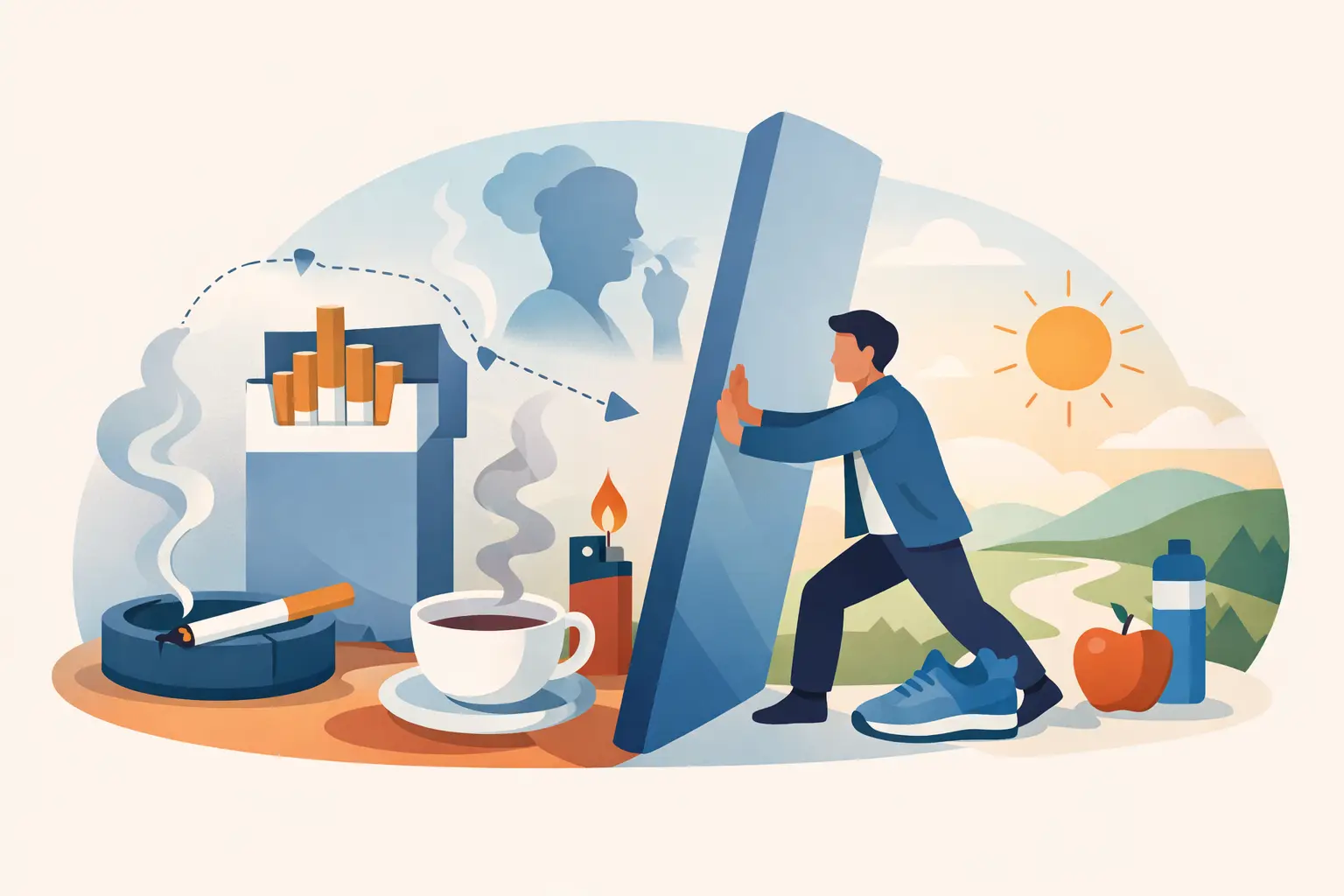
A cigarette craving can feel like it came out of nowhere. Usually, it did not. Your brain noticed a familiar signal: coffee brewing, a tense phone call, getting behind the wheel, stepping outside at work, or pouring a drink. Learning how to interrupt smoking cues means catching that signal before it turns into an automatic trip for a cigarette.
That matters because quitting is not only about nicotine. It is also about the routines nicotine attached itself to over months or years. You can break those routines. The goal is not to avoid every trigger forever. It is to build a new response that gives you more control when the old urge shows up.
What Smoking Cues Really Are
A smoking cue is anything your mind connects with lighting up. Some are obvious, such as seeing someone smoke or smelling cigarette smoke. Others are built into your day so deeply that you may not notice them until you try to quit.
For many smokers, the morning cigarette is not just nicotine. It is the first quiet moment with coffee. The cigarette after lunch may be a reason to leave the desk. The one in the car may break up traffic or boredom. During stress, smoking can feel like a fast reset button, even though nicotine dependence is often feeding the tension between cigarettes.
These moments are powerful because they repeat. The more often you pair a situation with smoking, the faster your brain calls for that same action next time. That is why a patch, gum, or pill may help with nicotine cravings but still leave a gap when your hands, mouth, and routine expect a cigarette.
How to Interrupt Smoking Cues Before They Take Over
You do not need to win an argument with every craving. You need to create a pause between the cue and the cigarette. Even a few minutes can weaken the automatic connection.
Start by naming the cue plainly. Tell yourself, “This is my driving cue,” or “This is the after-dinner cue.” It sounds simple, but labeling the moment separates the trigger from a command. A craving is a feeling and a learned response. It is not an instruction you have to follow.
Then change one part of the pattern immediately. Move locations, use your hands, take a drink of water, chew something, or step outside without buying cigarettes. If your usual routine is coffee on the porch with a cigarette, drink the coffee in a different chair for the first few weeks. You are not giving up coffee. You are retraining the connection.
A short delay is also a strong tool. Set a timer for five or ten minutes when the urge hits. During that time, breathe slowly, walk around the block, text someone, or do a small task that needs both hands. Cravings rise, peak, and pass. They may return, but each time you ride one out, you prove that it has a limit.
Build a Replacement for the Ritual
The most useful replacement is the one you will actually use in the situations that challenge you. If your biggest problem is nicotine withdrawal, a nicotine-replacement option recommended by a healthcare professional may be part of your plan. If the hardest part is holding, stepping away, inhaling, or taking that familiar break, you may need a behavioral substitute too.
That is where a nicotine-free, tobacco-free herbal cigarette can fit for some adult smokers. Smoke Free USA products are made with toasted cocoa bean outer layer rather than nicotine or tobacco, helping you keep a familiar smoking moment while working to remove nicotine from the routine. Regular, menthol, cherry, and vanilla options can make it easier to choose a replacement you will reach for when your usual cue appears.
Be clear about the trade-off: no smoked product is risk-free, because inhaling smoke can harm your health. If your end goal is to stop smoking completely, think of a smokeable substitute as a temporary bridge for the ritual, not a free pass to keep the habit forever. For many people, the immediate win is getting nicotine out of the cue. The next win is needing the cue less often.
Match Your Plan to Your Toughest Moments
Generic quitting advice can fall flat because your trigger pattern is personal. Focus first on the two or three moments most likely to make you smoke. Make a specific plan for each one before the craving arrives.
Coffee and morning routines
If coffee means cigarettes, do not rely on willpower while half awake. Change the order of your routine. Shower first, take your coffee on a short walk, or prepare breakfast before sitting down. Keep your replacement within reach so there is no scramble when the urge hits.
You can also change the coffee itself for a short period. Try a different mug, drink it in another room, or switch from a long, slow cup to a smaller coffee followed by something active. The point is to make the old smoking script harder to run on autopilot.
Driving and work breaks
Cars and break areas can be cue-heavy because they are repeated environments. Clean your car, remove old packs and lighters, and stock the console with water, mints, or another planned replacement. If you normally smoke as soon as the car starts, wait until you have driven for five minutes before making any decision.
At work, protect your break instead of treating it as a cigarette-only privilege. Still step away from the screen. Still get fresh air. Still talk to coworkers if that helps. You are keeping the relief and separation from work while changing what happens during the break.
Stress, anger, and difficult conversations
Stress cues can feel different because they are emotional and urgent. A cigarette may seem like the fastest way to calm down, but it often becomes the only coping move your brain remembers. Give yourself a two-step response: first, slow your breathing for one minute; second, do something physical or sensory before deciding what comes next.
Cold water, a brief walk, a shower, music, or simply standing outside can create enough distance to stop a stress spike from becoming a smoking episode. This will not make the problem disappear. It gives you a chance to deal with the actual problem without automatically adding nicotine to it.
Cocktails, parties, and smokers around you
Social triggers often need a boundary, especially early on. You may choose to skip certain drinking situations for a few weeks, limit alcohol, or tell friends you are changing your smoking routine. That is not weakness. It is smart planning while the new habit is still getting stronger.
If you do go out, decide in advance what you will hold, where you will stand, and what you will say when someone offers a cigarette. A simple “No thanks, I’m off nicotine” is enough. You do not owe anyone a long explanation.
Track Progress Without Beating Yourself Up
For one week, write down when you want to smoke, what happened right before it, and what you did instead. Keep it short. A note like “3:15 p.m., work frustration, walked outside and had water” is enough. Patterns become visible quickly.
Do not treat a slip as proof that you cannot quit. Treat it as information. Maybe your plan worked at home but not after two drinks. Maybe you need a replacement in the car, not just in your kitchen. Adjust the plan for the cue that got through.
The goal is progress that holds up in real life, not a perfect performance. Each interrupted cue teaches your brain a new lesson: coffee can be coffee, driving can be driving, and stress can pass without nicotine calling the shots. Keep taking the next familiar moment back, one choice at a time.