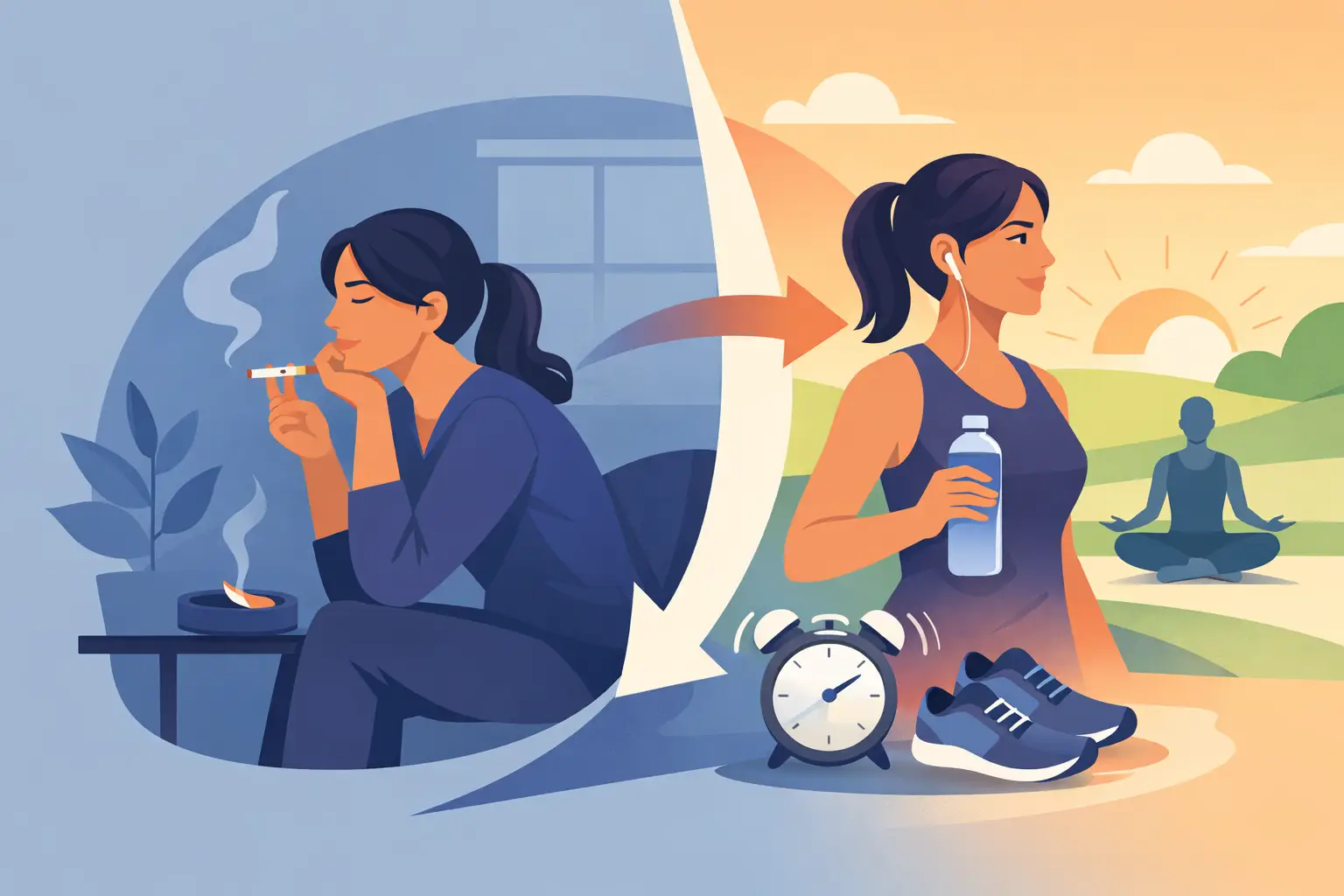
A cigarette is rarely just a cigarette. It can be the five quiet minutes before work, the companion to morning coffee, the reason to step outside, or the familiar reset after a stressful call. That is why learning how to replace smoking rituals matters. You are not only changing a nicotine habit. You are rebuilding the moments that nicotine attached itself to.
If patches, gum, or medication have left you thinking, “But what do I do with my hands?” you are not failing. You have identified the part of smoking that many quit plans miss: the ritual. The good news is that routines can be changed. You do not have to white-knuckle every coffee break or avoid every social situation forever. You need a replacement that fits the moment and a plan you can actually repeat.
Why smoking rituals are so hard to break
Nicotine creates chemical dependence, but repetition gives smoking its staying power. Your brain learns the pattern: coffee means cigarette, driving means cigarette, stress means cigarette. Eventually, the trigger can create an urge before you have even made a conscious decision.
That is why simply removing cigarettes can leave a real gap in your day. The gap may include a hand-to-mouth motion, a reason to pause, the feeling of inhaling and exhaling, a familiar taste, or a few minutes away from pressure. A successful replacement strategy respects that reality instead of pretending it does not exist.
The goal is not to preserve every part of smoking forever. The goal is to separate the ritual from nicotine, then build new routines that give you more control with each repetition.
How to replace smoking rituals one trigger at a time
Trying to fix every smoking moment at once can feel overwhelming. Start with the situations that cause the strongest pull. For many adults, those are coffee, work breaks, driving, meals, alcohol, and stress. Choose a replacement before the trigger hits, not while you are already bargaining with a craving.
Replace the coffee cigarette
For many long-term smokers, coffee and cigarettes feel like one routine. Do not begin by forcing yourself to give up both if that makes the morning feel impossible. Keep the coffee, but change what happens around it.
Try drinking it in a different spot, using a travel mug on a short walk, or pairing it with a nicotine-free, tobacco-free herbal cigarette if the physical smoking routine is the part you miss. The point is to show your brain that coffee can still be your moment without delivering nicotine.
If you usually smoke on a porch or in the car before work, use the same location at first if it helps. Later, when the urge is less intense, you can change the setting too. Small changes often stick better than an all-or-nothing morning overhaul.
Rebuild the work-break ritual
A work-break cigarette is often less about smoking than permission to stop. You stepped away from the screen, got outside, moved your body, and had a few minutes without anyone asking for something. Keep the break. Replace the nicotine.
Set a timer for the same time you would normally step out. Take a lap around the building, stand outside with water, stretch your shoulders, or use a familiar smoking substitute. What matters is that the break still feels like a break, not a punishment for quitting.
Tell yourself something simple: “I still get my five minutes.” That shift matters. You are not giving up your right to pause. You are taking nicotine out of the pause.
Plan for driving before you start the engine
Cars can be powerful trigger zones because smoking filled empty time and helped manage traffic frustration. Prepare your car so the old routine is not the only option. Clear out lighters, ashtrays, and open packs. Keep water, mints, sunflower seeds, or a straw available for the hand-to-mouth urge.
For smokers who miss the act of holding and smoking a cigarette, a nicotine-free herbal option can be a practical bridge on familiar drives. Smoke Free USA offers tobacco-free, nicotine-free herbal cigarettes made with toasted cocoa bean outer layer, including regular, menthol, cherry, and vanilla choices. They can help preserve a familiar smoking moment while you work on breaking nicotine dependence.
They are not harmless because inhaling smoke can irritate the lungs, and they are not a reason to smoke more often. Think of any smokeable substitute as a deliberate tool for specific high-risk moments, not an automatic replacement for every cigarette.
Create a stress routine that actually gives relief
Smoking can feel calming, but much of that “relief” is the end of nicotine withdrawal. Still, the pause itself can be valuable. You need a new stress ritual that gives your body a clear signal to slow down.
When stress hits, try this sequence: step away, take ten slow breaths, drink something cold, and give your hands a job. If you want to keep the familiar smoking ritual during the early stages of quitting nicotine, use that option intentionally. Then ask what triggered the urge. Was it anger, boredom, overwhelm, or the need to escape a conversation?
This is not about becoming perfectly calm in thirty seconds. It is about creating enough space between the feeling and the nicotine decision that you get to choose what happens next.
Keep social time social
Cocktails, parties, and friends who smoke can make old habits feel automatic. You do not have to disappear from your life to make progress, but you do need a plan before you walk in.
Decide what you will hold, where you will stand, and what you will say if someone offers a cigarette. A simple “No thanks, I’m off nicotine” is enough. Bring an alternative for your hands and take brief breaks with people who are not smoking when possible.
Alcohol can lower your guard, so this is one situation where it helps to be honest about trade-offs. If drinking reliably leads to smoking, take a short break from alcohol while you establish your new routine. That is not weakness. It is smart strategy.
Make your replacement easy to reach
The best ritual replacement is the one you can use at the exact moment you need it. Keep your chosen tools where cigarettes used to live: in the car, at your desk, in your bag, near the coffee maker, or on the patio. Friction matters. If your replacement is hard to find, the old habit has an advantage.
It also helps to match the tool to the trigger. A mint may be enough after lunch. A walk may work for a work break. A nicotine-free herbal cigarette may make more sense for the coffee ritual or the first social event where you expect strong urges. You do not need one perfect answer for every situation.
Be careful not to replace smoking with constant snacking, endless scrolling, or another habit that makes you feel worse. A replacement should give you a pause, a sensory cue, or something to do with your hands without quietly taking over your day.
Track wins, not just slips
A slip does not erase the cigarettes you did not smoke. If you had coffee without nicotine for three days and smoked on the fourth, you still proved that the ritual can change. Look at what happened, adjust the plan, and try again at the next trigger.
Write down the moments you handled differently. Maybe you drove home without stopping for cigarettes. Maybe you sat through a stressful meeting and waited ten minutes before acting on the urge. Those are not small victories. They are evidence that the old pattern is losing control.
If nicotine cravings feel unmanageable, consider adding proven support such as nicotine replacement therapy, prescription treatment, counseling, or a quitline. A smokeable ritual substitute may fit alongside a broader quit plan, but support works best when you use it consistently and talk with a health professional when you need help choosing an approach.
Give yourself a new script
You do not need to become someone who never takes breaks, never needs comfort, or never enjoys a quiet moment outside. You are building a new script for those moments, one where nicotine no longer gets to call the shots. Start with your next cigarette trigger, choose the replacement before it arrives, and let one changed ritual become proof that you can take the next one back too.